


Artificial intelligence (AI) is rapidly changing the way we work, learn, and communicate. Across industries, AI tools are helping organizations automate tasks, generate content, and improve efficiency at a remarkable speed.
Not surprisingly, these changes have sparked growing anxiety about the future of work. Headlines regularly ask which jobs AI will replace, which careers are safe from automation, and whether entire professions may disappear altogether. The anxiety of the unknown is understandable.
However, focusing only on replacement may obscure the more important story—and a far more empowering potential future. Rather than reducing the importance of human capabilities, AI is changing the kinds of human capabilities that matter most.
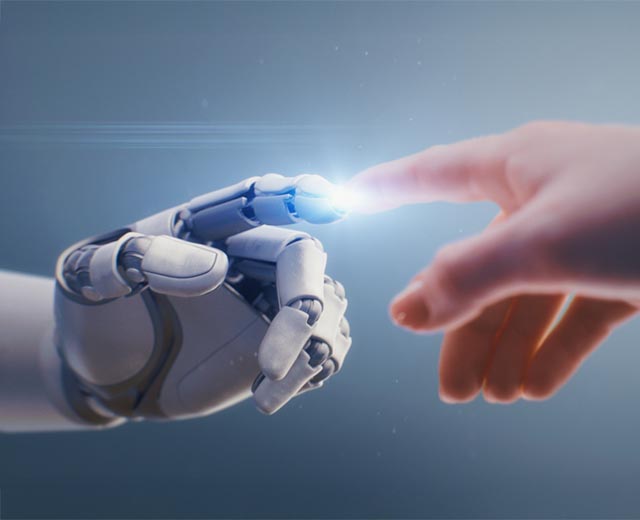
The future is unlikely to be defined by humans competing against AI. Increasingly, it will be defined by how effectively humans learn to work alongside intelligent systems while still keeping hold of judgment, responsibility, and meaningful human agency.
AI Is Changing More Than Jobs
It is no secret that AI is already reshaping industries from healthcare to business to education. In the healthcare field, for example, AI technology is being used to improve medical diagnoses and early detection, inform treatment plans and patient monitoring, and conduct drug discovery. Industries like banking are using AI to support customers, prevent fraud, and identify anomalies and financial crimes. Tasks that once required significant human time can now be automated or accelerated through AI-enabled systems.
AI can summarize reports in seconds, generate software code, analyze enormous datasets, draft communications, and produce content almost instantly. As these systems improve, some forms of routine and procedural work will likely continue to decline. Data presented by Harvard Business School illustrated that in the wake of ChatGPT’s launch, job postings for roles that have high automation exposure dropped by 13 percent while McKinsey estimates that AI technology in its current state could ostensibly transform upwards of 50 percent of current U.S. work hours, particularly in roles situated within the knowledge economy.

Historically, technological change has transformed labor markets. The first industrial revolution saw the rapid expansion of the use of steam and water power, which ushered in a production shift from cottage industries and artisan-made goods to mechanized manufacturing. The second industrial revolution saw the rise of mass production through the use of electricity. The third ushered in a shift from mechanical and analog controls to automation, digital computing, and information technology. Some have referred to the current disruptive moment as the fourth industrial revolution and have noted it began circa 2016 when technologies such as the Internet of Things, AI, big data, automation, and cyber-physical systems began being used to produce automation, efficiency gains, and workforce optimization.
But AI may represent something broader than just another wave of tech-facilitated automation. While previous technologies shifted labor markets primarily by replacing physical effort or repetitive industrial tasks, AI pushes into areas associated with cognitive work itself: writing, analysis, organization, research, and decision support.
That shift changes not only the types of work humans perform, but also what it means to participate in work at all. The European Commission refers to this phenomenon—a value-driven revolution in which humans work alongside intelligent technology to optimize productivity and process—as Industry 5.0.
2024 research from Workday suggests that organizations increasingly view AI not as a replacement, but as a catalyst that elevates the importance of distinctly human contributions. As AI assumes a greater role in information processing, routine analysis, and content generation, employers are placing increased value on capabilities such as ethical judgment, relationship building, communication, and the ability to navigate complex situations where human context and responsibility remain essential.
How Are AI and Human Intelligence Different?
This valuation of human intelligence should come as no surprise. AI is exceptionally powerful at processing information, identifying patterns, and generating outputs at scale. But human intelligence operates differently.
AI systems do not possess lived experience, moral accountability, emotional understanding, or genuine awareness of human context. They generate responses based on patterns in data, not understanding in the human sense of the word.
This distinction becomes increasingly important as AI systems become more capable. First, recognizing the difference helps us to remember that humans have agency and that machines cannot—and should not—be held accountable for complex decisions or their consequences. Second, understanding the distinction helps us to recognize when we are being deceived or manipulated by the AI systems we collaborate with.
How AI Skills Are Shifting from Knowledge to Judgment
For much of modern history, education and professional expertise were built around the idea that knowledge itself was relatively scarce. Development of specialized skills often depended on access to information, specialized training, or institutional authority.
Today, information is abundant and increasingly accessible. Prior to the current hype surrounding AI, YouTube videos helped usher in an age that has been dubbed the end of expertise. Yet, AI systems operate well beyond the capabilities of YouTube and can instantly generate explanations, recommendations, summaries, strategies, and analyses that once required significant human effort to produce.
But this abundance creates a different challenge.
When information becomes easy to generate, responsibility becomes harder. The human task shifts from simply acquiring knowledge to interpreting it responsibly. The growing challenge is deciding what matters, what is trustworthy, what applies to a specific situation, and what consequences may follow from acting on it.
In other words, the future may involve less scarcity of information and more scarcity of judgment.
The Human Side of Human-AI Collaboration

As AI systems become more integrated into everyday work, the most important professional skill may be learning how to collaborate with AI effectively without becoming overly dependent on it. That form of collaboration is more active than many people realize.
AI systems can generate answers quickly, but effective collaboration still requires humans to frame meaningful questions, recognize weak reasoning, interpret outputs within context, and decide when AI-generated recommendations should or should not be trusted. The process is not simply about accepting what the system produces. It is about engaging critically with it.
Salesforce suggests that human-AI collaboration is quickly becoming one of the defining workplace competencies of the emerging AI economy. In many professions, AI will increasingly function less like a replacement for human thinking and more like a cognitive partner that assists with research, drafting, analysis, simulation, organization, and problem-solving. But that partnership only works if the human stays mentally present.
It is the human partner who must provide contextual analysis, fact-checking, empathy and human understanding, moral reasoning, and ethical judgement. It is the human who must possess the ability to guide strategic decisions, maintain bias awareness, and ensure that an automated system’s actions align with an organization’s core values and the messy context of the embodied world.
A healthcare professional using AI-assisted diagnostics still needs to interpret recommendations within the realities of a patient’s circumstances. A business leader using predictive analytics still must weigh ethical consequences and competing priorities that extend beyond the data itself. An educator using AI-supported learning tools still must guide learners toward curiosity, confidence, and independent thinking, rather than passive dependence on generated answers.
In each case, AI may accelerate parts of the process. But humans still shape the direction, evaluate the quality of the output, and remain accountable for the results. That may be one of the defining challenges of the AI era: learning how to use intelligent systems to extend human capability without gradually outsourcing human judgment along the way.
Rethinking “AI-Proof” Careers
Many people are searching for “AI-proof jobs,” but that framing may oversimplify what is actually happening.
Very few professions will remain untouched by AI. At the same time, relatively few careers will become entirely automated. Instead, many fields are likely to evolve into forms of human-AI collaboration.

Healthcare professionals may work alongside AI-supported diagnostics. Teachers may use AI-powered tutoring systems. Managers may rely on predictive tools to support planning and decision-making. Creative professionals may use AI to accelerate production.
The question is no longer simply whether AI can perform a particular task. Rather, the bigger question is whether people can continue contributing thoughtful interpretation, ethical responsibility, and sound judgment while working alongside increasingly capable intelligent systems.
As AI absorbs more procedural and transactional work, the human contribution shifts toward navigating ambiguity, synthesizing perspectives, communicating clearly, adapting continuously, and remaining responsible for decisions made in complex environments.
Atlassian argues that the most effective AI-enabled teams are not the ones that passively rely on automation, but the ones that actively engage AI systems as collaborative tools while continuing to exercise human oversight and critical thinking.
Brian Eastwood of the Sloan School of Management at Massachusetts Institute of Technology validates this thinking when he notes that collaboration is most effective when humans and AI both do what they do best. This includes humans using their judgment to discern when collaboration with AI will outperform solely human or solely AI produced work.
Preparing for an AI-Enabled Future
So, what does this all mean?
Preparing for the future workforce now involves more than learning how to use AI tools; it also requires that we develop the ability to collaborate productively with intelligent systems while remaining an active and thoughtful participant in the process. That means learning how to
- Question AI-generated outputs rather than accept them automatically
- Recognize limitations, bias, and gaps in AI systems
- Interpret information within real-world human contexts
- Adapt continuously as technologies evolve
- Communicate effectively across human and technological environments
- Remain accountable for decisions even when AI contributes to them
In addition, research increasingly suggests that adaptability, curiosity, resilience, and continuous learning will become central to effective human-AI collaboration because they are foundational to one’s ability to use AI well.
Why adaptability and resilience? Because AI tools will change. AI technology will continue to evolve. And the context in which humans work will become increasingly ambiguous. The ability to remain agile and pivot when needed means one can evolve with this rapidly changing landscape.
Why curiosity and continuous learning? Because without curiosity and skeptical inquiry we may not be able to get the best results possible from AI, just as we wouldn’t from the humans we collaborate with. And, why be both agile and willing to engage in continuous learning? Because as thought leaders in business often note, “today is the slowest the world is ever going to move” and this means that technical skills that people possess could become obsolete more quickly.
To remain competitive, people must commit to becoming as dynamic as the world of work.
Education’s Role in This Transition
For many years, educational models have emphasized content acquisition and procedural performance. But in an AI-enabled world, learners increasingly need opportunities to practice interpretation, collaboration, ethical reasoning, adaptability, and judgment within complex and ambiguous situations. Recent global workforce research from Workday suggests that organizations increasingly view distinctly human capabilities as critical differentiators in AI-enabled workplaces.
As AI changes the nature of work, education itself may need to place greater emphasis on helping learners develop the capacities required to work effectively with intelligent technologies without surrendering independent thought in the process. Education is well positioned to do this work because it is synonymous with the transformative work that quality post-secondary education has always done: produce strong communicators, develop ethical decision making, exercise sound critical thinking, and ask the right questions.
This deeper level of AI competency will matter regardless of the academic program or career a person pursues. Those interested in exploring these emerging issues can do so at University of Maryland Global Campus (UMGC), where we offer two tracks within our online bachelor’s degree in artificial intelligence as well as an undergraduate certificate in Artificial Intelligence Foundations.
The Future Still Needs Humans
AI will continue transforming industries and reshaping many aspects of work while people will continue to respond to the AI revolution in many ways: from outright rejection to overdependence. But, the future is unlikely to belong either to people who reject AI entirely or to those who rely on it uncritically.
Instead, the future will belong to people who can work effectively with intelligent systems while still exercising independent judgment, discernment, responsibility, and meaningful human understanding.
The question is no longer whether AI is changing the workforce; that’s already happening. The more important question is whether humans will continue developing the capabilities needed to remain thoughtful, responsible, and fully engaged participants in an increasingly AI-enabled world.
Reference on this webpage to any third-party entity or product does not constitute or imply endorsement by UMGC nor does it constitute or imply endorsement of UMGC by the third party.