


What is a “growth mindset?” The term has become a popular boardroom buzzword in recent years—and for good reason. According to a report by TalentLMS, 80 percent of executives agree that a growth mindset is important for organizational success. As we observe Mental Health Awareness Month in May, we take the opportunity to understand this fundamental aspect of personal development.
Stanford University psychologist and author Carol S. Dweck, PhD, coined the term “growth mindset” in her 2007 book, Mindset: The New Psychology of Success. Dweck finds that believing in ourselves, in large part, is a matter of how we assess our own intelligence and character, as well as our capacity to change, that is, whether we have a fixed mindset or a growth mindset.
According to Dweck, people tend to fall into one of two groups:
Those who believe their intelligence and personalities are basically set by the time they're an adult are said to have a fixed mindset. Those who believe they can enhance their intelligence and improve their personalities through hard work, patience, persistence, and an open mind are considered to have a growth mindset.
Dweck finds that people with a fixed mindset are more likely to avoid challenges, quit in the face of obstacles, view effort as a sign of inadequacy, ignore or resist criticism, and feel threatened by the success of others. Conversely, a person with a growth mindset tends to embrace challenges, persist in the face of setbacks, view effort as the path to excellence, accept criticism and learn from it, and find inspiration in the success of others.
We asked Shruti Kulkarni, adjunct assistant professor at University of Maryland Global Campus (UMGC) in Stuttgart, Germany, to discuss the power of mindset from her perspective as a clinical nutritionist and public health scientist.
Q: What are the different types of mindsets?
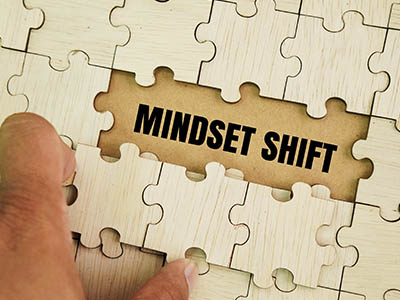
KULKARNI: In education and psychology, we often talk about two broad approaches to thinking about our abilities: fixed mindset and growth mindset. Teaching in an online learning environment, I see these ideas play out in very human ways.
In regard to having a fixed mindset, I sometimes see this in students who return to college after many years. A military veteran might write in the first discussion forum, “I was never good at science.” A civilian student juggling family and work might say, “Nutrition sounds interesting, but I’m not sure I can keep up with my personal commitments and then plan a diet.” This indicates a stage when the mindsets are fixed and not open to change.
On the other hand, in my nutrition classes at UMGC, a student who initially hesitates to participate starts asking thoughtful questions about public health, nutrition, or the food industry, then gradually about larger health issues and the impact of lifestyle on the community, and later on global scales. Confidence grows with engagement, and a growth mindset emerges.
Q: Are there any new trends in mindset research or understanding?
KULKARNI: Over the years, our understanding of mindset has become more nuanced. Researchers now recognize that mindset is not just about motivation; it is an emotion that is connected to how the brain learns and adapts, often explained through the concept of neuroplasticity.
In practical terms, neuroplasticity means that our human brains are capable of changing throughout life. I see this in our students, who, as adults with personal and professional responsibilities, can make their minds adapt to new things and adopt the best paths for achieving academic goals. This kind of resilience and openness to change demonstrates neuroplasticity in a real sense.
For adult learners in online programs, this is an encouraging message. Many of our students are active-duty military personnel, veterans transitioning to civilian careers, or working professionals returning to school after a long break. Their schedules are demanding, and sometimes they doubt whether they can succeed academically again.
Yet the online classroom—the environment, the faculty, and other students—is a space where they can rediscover their ability to learn and unlearn. Discussion boards, shared experiences, and reflective assignments allow students from very different backgrounds to support each other and interact in a collaborative spirit.
Another insight emerging in education is that mindset is contextual. A student may feel confident in leadership or management roles they are assigned to, but uncertain about specific topics in science courses. Part of our role as educators is to create a learning environment where curiosity is welcomed, where asking questions is encouraged, and where they can rethink their current mindsets toward particular topics, situations, and concepts.
Q: How is our mindset important to our overall health and wellness?

KULKARNI: From a health and nutrition perspective, mindset is deeply connected to health behavior. Our mindsets, combined with our surroundings, experiences, culture, and other factors, lead to personal choices.
If someone believes that their health cannot improve, they are less likely to make small but meaningful adjustments in their daily routine. On the other hand, individuals who believe that change is possible are more willing to investigate new health trends, adopt new habits, or implement lifestyle changes, whether that means improving their diet, managing stress, prioritizing sleep, or making other changes.
In many ways, mindset shapes how much we recognize learning and daily living as being cohesive and related, and how we respond to challenges in both. The way we think about ourselves, our health, our abilities, and our potential can largely influence the direction we take and the decisions we implement. In essence, what we think, we become.
Q: How does one move past common roadblocks toward a growth mindset?
KULKARNI: Shifting toward a growth mindset rarely happens overnight. For many adult learners, the first step is recognizing that inner voice that says, “I want to take this big step, but I’m not good at this.”
Some common roadblocks students share include
- Fear of failure
- Balancing coursework with work and family responsibilities
- Feeling isolated in an online learning environment
- Comparing oneself with others
Yet, it is often in these moments that growth begins.
I remember a student, an active-duty servicemember, who had indicated he hadn’t taken a science course in almost two decades. By the end of the semester, he was leading thoughtful discussions on food environments and public health policies. His newfound confidence didn’t come from knowing everything; it came from staying engaged, learning with fellow students, and being open to ideas.
One aspect of UMGC’s online learning is that we encourage students to focus on progress rather than on perfection alone. Learning sciences, processes, business, nutrition, or public health concepts can feel overwhelming initially, especially for returning students who may be unsure of exactly why they’re taking these classes. At UMGC, our contextual and conceptual learning process is designed to teach you how to learn new things, not to just unlearn old things.
Q: What are the benefits of a positive or growth mindset?
KULKARNI: A growth mindset brings several benefits, both academically and personally. Students who approach learning with openness and curiosity tend to
- Stay motivated even when coursework becomes challenging
- Reflect more deeply on feedback
- Build resilience during busy or stressful periods
- Engage more meaningfully with their peers
In online education, this mindset also strengthens the sense of community bonding. Students learn not only from course materials but from each other’s experiences, whether those experiences come from military service, healthcare, business, or family life. They openly share and ask questions, helping others to start engaging with classmates, and facilitating a healthy discussion environment.
Q: How can developing a growth mindset improve academic performance in online degree programs?

KULKARNI: Online learning requires independence, discipline, and a willingness to engage actively. Unlike traditional classrooms, students must create their own learning rhythm or momentum.
In my experience teaching nutrition from a public health perspective at UMGC, students who embrace a growth mindset tend to thrive in the online environment. They ask questions, they participate in discussions, and they connect course concepts to real-life situations.
For example, military students often relate nutrition topics to operational readiness and long-term health after service. Civilian students might connect them to family well-being or community health initiatives. These personal connections transform learning from a requirement into something meaningful. Perhaps that is the essence of a growth mindset: recognizing that studying is not simply about earning a degree; it’s about expanding one’s perspective, developing the ability to adapt and adopt, and continuing to grow throughout life.
A growth mindset, especially in online learning, often works in exactly that way. Information stored inside can only help you know your surroundings, but if implemented and put to use at the right time and place, it can truly help you progress academically and professionally. And it reminds us that if you light a lamp for someone else, it will also brighten your own path.
Reference on this webpage to any third-party entity or product does not constitute or imply endorsement by UMGC nor does it constitute or imply endorsement of UMGC by the third party.