


Building True AI Literacy
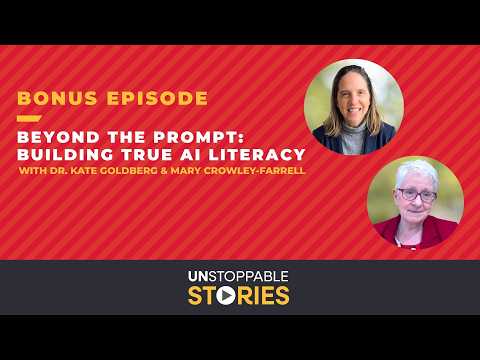
In this bonus episode of Unstoppable Stories, host Nathan James brings together UMGC faculty members Dr. Kate Goldberg and Mary Crowley-Farrell for a dynamic, forward-thinking dialogue on artificial intelligence in higher education. Together, they look past the baseline tech and examine the core issues of equity, digital awareness, and why AI literacy must go deeper than learning how to input prompts.
Mary shares crucial insights from the communications and journalism landscape, explaining how machine learning impacts human collaboration, the vital necessity of interrogating our tools, and how AI can sometimes have a "blanketing effect" on natural human curiosity. Dr. Goldberg addresses the rapidly evolving data science field, arguing against the potential "extinction of the expert" and highlighting why domain expertise is more valuable than ever to identify bias, inaccuracies, and ethical gaps in automated outputs. From restructuring assignments around real-time problem-solving to balancing AI assistance with peer review, this conversation provides a necessary roadmap for educators, students, and workforce professionals striving to remain authentic and adaptable in a machine-assisted world.
Episode Information
Nathan James
Hello and welcome to a bonus episode of the Umgc podcast on Stoppable Stories. Today, we feature a topic that should interest everyone Umgc faculty members discussing artificial intelligence. We will hear from our own Kate Goldberg and Mary Crowley Farrell. We hope you enjoy this episode.
Dr. Kate Goldberg
So Mary AI is obviously already present in the classroom. What challenges are students facing and how are you upskilling the learners? What tools are you equipping them with to help them get their skills to the level that they need?
Mary Crowley-Farrell
Yeah, there's a lot of questions there. The for me, the challenge with working with the students is their attitude. Getting them to understand how they're working with AI or why they're using it, as opposed to what they could be doing in preparation for their careers in the communications field. It's an awareness issue. A lot of students are very comfortable with technology, and a lot of it's like a Byford split between the class.
You've got a lot of students that understand how to use AI, or at least are using AI, and then a lot of students who have no idea what it is. And for us, we need to acclimate them to how the tools might be used in the communication field. It's not so much to right. And that's becoming increasingly clear in the complaints that we hear and read and see in the news.
It's that they need to learn some more sophisticated skills, many of which are the kind that you teach how to analyze the data, how to extract data, how to find data. And those are the top skills that the communication professionals that we're working with in our field need. It's also showing them that accessing AI is a is a privileged stance, and that they have it and that others don't.
That's something they don't. They come into the picture. They didn't have no idea. No idea at all.
Dr. Kate Goldberg
When I think about 6 or 7 years ago, we didn't have access to a learners, didn't have easy access to AI. We were having to get access through special IBM tools. And our challenge in the data science and AI field was getting exposure to learners in the first place. It was a it was a very difficult space, but then it opened up and now the challenge is no longer putting learners in front of AI.
Now we need to teach them how to be effectively using AI. And I think that because that generative AI tools became readily available so quickly, that the AI literacy has not caught up. And that's where I think that higher education needs to be. Focusing is on making sure that we're bringing everyone up. Like you said, the equity issue of we need to bring everyone up in terms of their AI literacy, that's going to be everyone, right?
That's not just going to be their learners. It's our faculty. It's our staff. It's everyone that's in higher education. It's in the whole, I would say the workforce in general, too. It's not just a unique problem to higher education.
Mary Crowley-Farrell
Oh, and the definition of what AI literacy is, is, is extremely important to understand. And I don't think a lot of our students know that. The difference is it's not the skill that we are teaching. Faculty misunderstand that as well. It's the understanding of what the tool can be doing in your process and taking away from the process.
In journalism, the the process is all about the question. You have to be able to ask a question, and with AI, you have to be able to interrogate the tools as well before you have a satisfying set of content.
Dr. Kate Goldberg
And the next part is evaluating the answer. So that's what I have seen is a challenge for a lot of people I talk to, whether they're in education, whether they're in business, wherever they're working is. A lot of people come to me and say, oh, I plug this into AI tool, and these are these are the results I got.
But this isn't what I wanted. And I say, well, that's the part where you being a human is really important. You need to be the expert in the room and say, this doesn't make sense, or why did it spell this wrong? Or why is it putting an image of this? That's those critical thinking skills that our learners need.
And that's where I see education playing a role in AI literacy and just in the classroom in general. Just okay, so now you know how to you've asked a question, what does that answer mean? So that's I think that's that challenge. We now there's maybe there's AI in the classroom. Either we've we've added it as part of our curriculum or they're bringing it.
But how are we going to challenge students with really evaluating those answers?
Mary Crowley-Farrell
There are so many fun ways to do it too. I mean, I have my students look at Instagram news because there's a lot of influence that influences out there who trying to present the day's news. And last night we were looking at one. It was legs and arms, but there was no body in. And you've got to say, what am I producing here?
Why am I doing this? Is this the product I'm supposed to be having out there? And the students found that very enlightening, because they don't always go back and look at what they have produced. It's for them. So natural now to be on any of the social platforms. So this is a whole new awareness that is a part.
And we teach we're starting to teach them more about thinking digitally, visually, which is very, very important now.
Dr. Kate Goldberg
Something that I've also liked to do in discussions with my in my classes is have a learner, use an AI tool, post their results, share the tool that they use. So tell their classmates, I used this tool and these are my results. Then the what I'm having learners do is compare. So maybe try try a different tool. What was the difference?
Did you like one versus another? Did one work better than another? I think that that discovery is is equally important as evaluating the. The output is to understand how did the tool help them so that they can make a better decision going forward. So that's that's something that I'm seeing. But I'm also another point that I keep reminding myself and my learners is the responsible use is important.
It's something we haven't talked about and I'm sure we'll get into that. But just constantly reminding them about privacy issues, ethics bias, privacy, transparency and accountability. So those are all focuses I know we'll talk about later.
Mary Crowley-Farrell
What AI related skills do you believe every college student needs when they graduate, and does it differ by feel?
Dr. Kate Goldberg
That's a great question and it's something I struggle with. I teach AI, I teach courses in AI for everyone, so we I teach that, but I also teach courses for people who are going to focus their career on future solutions for AI. So I personally see a challenge, but I think that the workforce, I think employers are looking for learners who have that AI literacy.
Not everyone needs to be an AI specialist, but every graduate should understand capabilities and limitations of of the tools. Again, those critical evaluation skills they need to be able to identify is something inaccurate. Is our bias. Is it incomplete? Is it misleading. That's that would be terrible if they I what I want for our for graduates of any university to come away with is that when they start a new job or they, they maybe start a new role that they are able to really be able to answer and solve a problem that can use AI, but in the right way, because it's not always the right tool.
And I think that that's something a lot of people are. Some people are over relying. So they're saying, oh, I'm just going to go to AI for that, where it might not be appropriate. So I think learning when is it appropriate? This is the right tool I need for this versus. And I'll give an example. We a lot of people know how to use Microsoft Word and they know how to use Excel.
Well I wouldn't go into Excel to write a word document because I've learned when it's appropriate to do one or the other. So I really am hoping that higher education can bring that part. Obviously, erase AI literacy, but also bring the appropriate use of tools to to learners. Because I, I had a conversation with someone who recently hired an intern and an AI intern and they said, well, this in turn has a had a very impressive academic resume.
However, when they got there, they couldn't use a specific tool. And I challenged back to this person. I said, well, the intern has been taking courses, but why did you assume that they knew how to use that tool? And they said, well, I just assume that if they've been doing AI, they should be able to do all of them.
And I said, well, I think that's something you really need to think about, is it's not one tool does not fit all, and one tool does not solve all. So that's something else that I really think learners need to be able to do, is to be able to learn how to be flexible, learn how to understand the tools.
And I think that they they need to embrace the constant need of learning that you can't just be satisfied. You can't. You're not just going to say, oh, I know how to use this tool. I'm done. Check. Mark, you need to keep learning.
Mary Crowley-Farrell
I think we also have to do that with the faculty. A lot of faculty don't know how to use the tools because it wasn't a part of their formative years. And if they're not in the field anymore, if they're strictly academic, they may not know how to use it either. In communication and journalism in particular, all of the instruction, all of our content, our curriculum is, is around competencies that are, well, some folks would call them soft skills.
Now we're talking about them as more adorable, but we don't focus on the use of the tool. We focus on the what it is, the process that you're using it for. And one of the things that beyond ethics, I mean, we can ask them that, but this collaboration in the communications field is absolutely essential. And what we're now fighting with is the notion that when they use an AI tool there alone, they're not collaborating with humans.
And this skill is so critical to be able to collaborate. So we have a whole new issue that is the tools have created for us. But at the other side, it's it's all about asking questions, all about looking at the content and analyzing it, because we have to look at content anyway. That is what the whole job is about.
So those skills are just naturally baked into what we're doing. But this whole new thing with collaboration, very hard, very hard.
Dr. Kate Goldberg
That's really interesting. I'm curious, have you experimented any like have you experimented with any assignments or any approaches where learners are collaborating with each other? Humans plus AI? I'm curious about that.
Mary Crowley-Farrell
Yeah. Yes, we're working on because peer review, working with another, working with an editor, working with a senior editor, working with another reporter, that skill of being able to look at the content and ask questions of each other. Did you think about this? Did you do that is being challenged in the classroom? Because if you're working with the AI, do you need the your classmates?
So we're trying to bake in, practicing with working with your classmates first, and then seeing how the AI tool will react to the edits and changes you had, and then going back with the classmate and say, so here's what we've got. It's it's like working with your colleague in the newsroom, for example. But at a it's more intense because you're back and forth.
The time is different. It's more real time in the in the newsroom. And it's not quite the same in an asynchronous classroom. But yes, we are trying to teach them how to do peer review and still be able to use the AI tool as needed. Mostly we're using AI to extract information from other sources.
Dr. Kate Goldberg
That's really interesting. I can't wait to see how those courses or how that develops. So here's another question for you. Related to that, how are you thinking about authenticity and credibility in the work our learners are producing that we know AI can polish it. We know it can analyze. We know it can even do presentations, even like voice presentations.
So how are you ensuring that that authentic approaches is happening in your classroom process?
Mary Crowley-Farrell
The authenticity for us is in the process. Seeing them create along the way and work working with each other or not. The whole idea of process is important to us. It's not the product that we're worried about. So if they wanted to use a new tool for them because many of them are very PowerPoint oriented, they already know how to do that with the their in the workplace.
But to use a new tool to create their product still requires them to engage in the process of writing it, of learning how to communicate it so we don't stand in the way of them. Using a different tool for the product. We focus on the process, and that's not necessarily what other fields might do, but that's what we do anyway.
In the writing process in the newsroom, you're looking at the process.
Dr. Kate Goldberg
I have recently been thinking about this in terms of a lot of the classes I teach, just thinking about the process of data analysis, which is storytelling. That's how I think of it as data storytelling. And I want to reinvent a lot of our traditional assignments where for us, maybe we give a learner a data set and we say, go explore this data set.
Tell me if there's outliers. Tell me what patterns you see. And I might ask them a lot of questions to lead them through the process of data analysis workflow. And it's very easy to do that using AI. I can I can just drop it in a tool and tell me to tell me to do it. That's what I want now for my learners is I want to hear their reasoning.
I want to hear what I so I'm asking for at this point, I'm asking for videos of them explaining what did you what happened when you found this outlier? Did you decide to delete it? Are you going to replace it with an average? How are you going to handle this. So asking them to to share their reasoning and asking them to to talk about how did they problem solve.
And I think we're educators. We need to give people the space to not be perfect. And students probably I'm including myself in this. I want to I want things to be polished. I want it to be right. I think that giving people a space to experiment and it doesn't have to be perfect, is something I want to continue to emphasize that I know that this is the first time you're practicing this skill, and it's okay if you don't get it right the first time.
I think that building that into my my own teaching is really important, so that my learners don't over rely on AI. I want them to be able to pause and say, I'm going to do this on my own. I'm going to try this. And it might be difficult and it might be uncomfortable, but that's okay. I want them to feel that that learning process, even though it might be difficult, is okay.
And don't just use don't just go to an AI to immediately. I really want them to to experiment. I don't know how successful I'm going to be, but I'm going to keep trying because I know how hard it is. I know this is why they need this is why they need training this. Is that why we need expertise is because this isn't hard, and this is what makes humans amazing, is that we can reason and we can think this through and we can solve problems.
So I want to keep that essence in my courses.
Mary Crowley-Farrell
Common journalism are all oriented to reality. They have to go out and ask questions of people. They have to decide what people are. The relevant people. To ask those questions of the editor is what all the faculty are like editors, their coaches. They're saying, what are you going to ask? Who are you going to ask? The result coming back is the how do you put it together?
But that's of less importance than making sure they learn how to go out and, you know, ask real people questions. And we do have students who try to get away with not doing that, which we can recognize because we know who they're supposed to be asking questions of. So it's we have that one step up on some of the other instruction because we have to force them out into the field.
Dr. Kate Goldberg
That's interesting. I was going to ask you, how do you distinguish between a AI created product and I don't and a learner created product. And you just said you you can you can just tell. So that's that's very interesting. I, I find it challenging sometimes I say to myself, how can I tell. And, and I, I'm finding it more challenging every day.
Mary Crowley-Farrell
Well, it is in a sense a crisis though for us because we work with cases. So we give them case studies. And yes, you probably know from using case studies yourself if they are canned, if they're not real life, it's very easy for them to go to the AI and use that to sort out how they should do something.
We are we give them real life ones. What's something that we have just seen in the news and we stick to local news, and then we have them go out and cover it. And that allows us to be more the process, to be more authentic, but it's also more difficult for the faculty. So it is it's because it's it's asynchronous environment.
If we were working one on one the way some of the we have system colleges that do that in the program and they're out in the real world, you know, talking to humans and the faculty as well. It is easier. So that is our challenge, is keeping it real.
Dr. Kate Goldberg
And I would imagine and it doesn't matter. The discipline responsible use is at the heart of all this. And having that conversation that they need to represent. Where did this come from? And can they talk about the source of the data? Can they can they pinpoint and say, this is where this answer came from with AI tools that I'm going to say almost impossible.
I might even say it's impossible. They think that they know, and maybe some of these tools might give you a fallacy that you can tell because, oh, you can, you can click to a link. But is that really finding the real answer? I challenge that. So I think that because so many in so many industries is when you when you're a reporter and you report on something that's your word, right?
That's your trust with the public that you've done that. And I think that emphasizing that, I'm sure that that's something that you all emphasize is that responsible use. I know I think about my different different learners could be like, I think sometimes I could have learners that work in the health care field. They might be people that are working at my local hospital, and if they're using AI to make decisions for my health or my family, I want them to be critically thinking about this and reflecting on, well, we talked about this earlier outputs, but I want them to not be relying on that AI.
I want them to be thinking about their training and and their expertise.
Mary Crowley-Farrell
So and Kate, it becomes hard in some fields. And I was thinking about this last night. In some fields like math in our classes, the students talk to each other, they share information. They will. And I'll get to a little story here in a moment. But in a math class where your focus is on maybe the answer, I could be wrong about that.
But other than geometry, when I can remember being told, show the process. So the process, maybe it's not showing the process so I can see where it's going to be harder to do some of these things that we do. On the other hand, I can see that we're going to have trouble doing some of the things that are easy in the other field.
We because of that, we encourage students to talk to each other. They share sources. So I can remember a couple of semesters co getting telephone calls from the source saying tell them to back off, please. I've gotten like 15 goals from this and I and I had not thought about that at all. So yeah, there's it it's very much nuanced use.
Dr. Kate Goldberg
Well I do want to circle back to math. I was a math major, and I will say that for my learning, at least for mine, the process was the most critical part of my learning. So I had to write papers justifying why I chose a certain formula or a certain proof. So it wasn't. It's not as you're thinking, it's concrete.
It's actually not because there are there's a decision making workflow that you go through in math. And so I would say that I had to write papers about my math, my math projects, and talk about the problems that I solved and how I could solve it.
Mary Crowley-Farrell
I recently had to learn some statistics for research I was doing, and I hadn't learned the formulas ever before. In this particular thing. I think it was regressions and chai, and I went to the AI, and the AI not only showed me how to do it, which I had to check against a book to see if that was right, I at least checked it.
It told me why and I thought, oh my goodness, I don't need to go to class for this. Thank God I was giving something. I was giving some thought to that as an for my lifelong warning. It was telling me what to do so I could see that there's a there's an area we have to think about, right.
Dr. Kate Goldberg
Well, we don't, because if you haven't learned the skill, so you at some point took a statistics course and you knew the background, but if you don't have that fundamental understanding of math, you will just blindly trust the answer. How can you evaluate? So I think that in higher education we have to continue emphasizing that domain knowledge, the domain expertise, what you're learning, we can't we can't let people just have a fallacy that the AI is going to always be right.
We need to do that because luckily, in your situation, I'm going to trust that at some point you took a statistics course because the wise educators, when you were going to school said, oh, everybody needs statistics, right? And they knew that at some point that was going to help you. And they were right because it did. But we don't want to lose that.
We don't want to take that out of our curriculum. We want learners to continue to do this, and they need to be building their expertise so that they can become the domain experts, so that when they use an AI tool, they can be the ultimate judge, and they can help to make sure it's it's responsible and ethical. So this is this is why it's such a complicated topic.
Mary Crowley-Farrell
What do you define as authentic learning though? I mean process can be authentic. Is that is that what we mean by authentic learning?
Dr. Kate Goldberg
I think this continues to evolve. I can remember going into classrooms with my blue book and having to right hand write out my essays for my courses, and I can remember scheduling oral exams.
I think a lot of people in the past and right now would say that's an authentic use, the authentic way to evaluate a learner. I think this is evolving in higher education. I don't think it's as simple as I've heard people say, oh, let's go back to Blue Books. I understand that obviously that's not going to happen, but I think we need to think about what is authentic use, because if we continue to talk about AI as a tool, then why?
What's different than a calculator? Like, I was able to use a calculator in some of my math classes because I understood at least the basics, and they got me to a level where I was able to use that. So I would like to hope that at some point we're going to be able to increase AI literacy, so that when people use AI tools, they're I'll say product will be able to be authentic, but also we'll be able to ask them about the process and they will be comfortable sharing how they how they did that and be authentic in sharing their process, how they they thought about it.
What did they where did they stumble? That's what I want to hear. I would like to ask a question. What surprised you? What did you not understand? What are your what questions are you left with? I sometimes build that into my homework assignments. That can be a that can be part of your homework is to tell me what do you not understand?
That's okay. I think that's okay.
Mary Crowley-Farrell
Yes, I totally agree with that. It's the questioning of ourselves, you know, because for a journalist, there's a format as if you're writing news, there's a format to presenting it to make that format, which is the five W's and H questions that we teach in all kinds of.
Dr. Kate Goldberg
It works for everything.
Mary Crowley-Farrell
It works for a lot. But there's a structure that is supposed to be presented in, in our writing, and that requires decisions about what's important to say. So we actually have it baked into the stories in what we've discovered. This is not going to last long, but AI is not smart enough yet to do it for itself and reflect the human kind of judgment.
But that's not going to last. That's something. So we as an institution have to constantly be changing more than we have in the past. And our tradition hasn't been to change that fast. So we're going to have to we invent higher ed. I totally agree with that. That perspective that we do hear it out there, people talking about it.
But yeah.
Dr. Kate Goldberg
Well, this is a great segue for my question. If you could redesign one part of higher education today, I know this is a big question. What would you change first?
Mary Crowley-Farrell
Oh.
Mary Crowley-Farrell
The answer is so controversial. We've always valued the wise ones, who tend to be the practitioners who have retired. We can't do that anymore. The people like me need to be gone because we're not close enough to the changes and why we are changing. We don't change fast enough. It's a very horrible I mean, I'm being terrible with this generalization.
It's really too broad. There are lots of people who are my age who are very engaged and plugged in, but there's also a lot of what feminists and some others would say is Western white thinking in our traditions. And we need to change that. And part of that is to take the age factor and question whether they are still sages, because we don't want sage on the stage.
We love to use that phrase. But we also want the editors in our field to recognize when this is a great moment for multimedia.
Dr. Kate Goldberg
Well, Mary, I'm going to challenge this because I'm going to argue the opposite. I think that we need sages. I think there's going I think I'm afraid this is a real fear. I'm afraid that we're at the edge of the, I'm going to say, the extinction of the expert. So I'm worried that what's going to happen is that new, new journalists are going to develop their skills, and they are going to have this fallacy that they are experts in being a journalist or let's not say this, let's say they are experts in doing some particular kind of research.
I don't know your field very well, but what I worry about is that people are just going to say, well, I can use AI to do that. I think we need sages. I think that the sages or the people that are going to keep the work authentic, keep the human in the loop, challenge the results. So I'm going to disagree with you, Mary.
I think that we need the the experts and the sages and I that's I think we need that balance. We need the different we need as many different opinions in the room, challenging these questions and teaching learners how to how to be authentic and how to do this and I don't. So sorry, but I'm going to just say no.
Mary Crowley-Farrell
I love that I had not given any thought to extinction of the expert, but I am very. My recent research has been very focused on the loss of identity, the fear factor that faculty have. And it's.
Prevalent among the older sages that they feel like they're dispensable now and that their density has been challenged, that their whole life's purpose has been challenged to learn to be graduate students, to write the dissertation. All of that part of their learning is being challenged by AI, and I, I, I totally get the identity question. This is a great thing.
I'm gonna have to think some more about this.
Dr. Kate Goldberg
Well, I think the challenge would be how do we show that that's a valuable voice in the room? How do we how do we make sure that we're including. I think that's a this is a really good topic for, for higher education, but I don't think it's just higher education. I think it's going to be all all industries.
I have a friend who is a computer programmer and he programs in COBOL. Okay. There's like a joke and I don't know if you've seen it, but it's like, oh, this, this thing does COBOL. And you know, oh, we can use AI for that. Well, I have a friend that's his. That's his job. And he was valuable to his company because he knew how to do that.
So I think this is a conversation that obviously everyone is having. But I think that it's interesting that you you picked up on this because I think that people at the beginning of their careers are probably feeling this way, and people may be towards the, I'll say, sunset of their careers are feeling this way. So I think it's probably just a normal human response to innovation or a change.
But I'm glad we're.
Mary Crowley-Farrell
Talking.
Dr. Kate Goldberg
About it. I'm glad we're talking about it so that hopefully we can we can keep finding.
Mary Crowley-Farrell
It's something that we need to remember to look to, to include, to thread into our faculty development processes. It's the whole how how the fear factors got to be there. And it's interesting that I have actually said out loud some private thoughts here, because I was an editor, and editors are the ones who got the first cut. Copy editors in particular.
If you look at our product nowadays, you'll see that there's a lot less perfection in the product. And that's because we took these experts out.
Dr. Kate Goldberg
Well, I guess this is a good time for my next question, which is, are there particular workforce skills or habits that you think have become more important because of AI rather than less important, so more important because of AI?
Mary Crowley-Farrell
One of our difficulties in our field is that we expect people to have curiosity. And I think AI has a a blanketing effect. It's like throwing a blanket over what your normal behaviors would be, and relying on the tool to tell you what you need to know, or tell you what you need to look at. And that's one of the problems.
So we don't normally we haven't had to teach how to be curious. And that's something I think we can learn from the science fields to do better, because it's you have a process in science, but everything else is pretty much the same. We want we teach them how to ask questions. We teach them the know. They need to have to ask questions, that the tool is not perfect, but the idea of curiosity, it's hard.
Dr. Kate Goldberg
I think what I'm also seeing is I think you're saying curiosity. I'm also thinking about judgment, I don't know.
I wouldn't say I, I, I've been teaching about judgment. That's not something when I, when I think about what I've been teaching up until now, I wouldn't often say, oh, I'm teaching my judgment. Obviously, we talk about critical thinking, we talk about that. But I think that that's that I said at the very beginning, evaluating the outputs is actually a skill that I think is going to probably be more important now that AI is in the picture in the workforce, because maybe before you were able to assume that judgment was inserted at a lot of different steps of whatever process it was.
But I think now if we think about that, judgment might not be there. I think we need to teach that. I think that's a skill and a habit that we also have to really practice, and I don't I'm still learning how to do that, but I think that's something that we need to bring back is that judgment and evaluation process in addition to curiosity.
Mary Crowley-Farrell
Well, in our field. The problem is that we use we've always taught them to be audience centric. You. Right. I mean, if you're going to write local news, you're writing it for a local community. It's what they need to know you. You learn how to do that. You learn how to do audience centricity and marketing in PR. But now that's not not clear.
That's not because you how do you teach that now when the audience is disparate? It could be anybody. But also the process doesn't require you to justify. If you use AI to justify the decisions, you have to. We have to find a way beyond the structure of the stories to present that information. You can see what kind of chaos this is can present.
Look at the CBS story right now. What is the audience? There's clearly a difference between the management's idea of what the audience needs and the reporters idea. And so it brings us back to teaching them to understand what the purpose of the First Amendment was. And that is not necessarily just writing to what the audience needs. So we have a built in tension right there in our principles that we haven't figured out yet.
Dr. Kate Goldberg
Something else that I think has become increasingly important. And again, I think that people always assume that someone else, maybe someone else was thinking about this, are principles related to ethics and privacy and yeah, yeah, transparency bias. I think that people just I don't know, maybe they assumed it was in there. I think that we need to keep improving, raising those skills for people entering the workforce so that they're the person in the room that questions why, you know, maybe they're asking like, why was this created?
Or why is this that, you know, whatever it is I want, I hope that our that learners, graduates of the next generation are going to have the moral, I'll say, gumption to ask these questions. And I, I think that that was on the I'd say that I'm just thinking about my own education. I think that we're on that was kind of always preserved, I'm going to say, like ethics was always preserved for.
I kind of thought of like philosophy majors or a medical, like the pre-med needed to do that. I don't think that we can do that anymore. I think that ethics bias, you know, being transparent and privacy, those should all be part of that AI literacy for everyone. It's not just privacy isn't just a cyber security person's problem, right?
It's not. It's it's everyone's problem. And the legal issues and the environmental, all of these things I think need to be part of the AI literacy before you can responsibly use these tools.
Mary Crowley-Farrell
Okay. But let me ask you this. How do you do that when the audience itself or the generation you're teaching is accepting, already accepts everything that these tools are doing in terms of invading our privacy.
Dr. Kate Goldberg
I think we have to keep talking about it. I think we have to keep demonstrating. I'm thinking of one. I took a course myself, and one of the projects was to understand Image Company, a company that sells images. That's their business. Our homework assignment was to see could we circumvent their watermark and could we produce images using an AI tool with those watermarks?
That should be not that it should be illegal. I mean, this company has spent millions and millions and millions of dollars to try to defend its its product, and it took me no time to basically create what they had done. I think that and I did this as a student. I was a student in a course and experimenting with that.
So I think that for me to learn about that, that it's, it's it's not a good thing that it's very easy to violate copyright and trademark with these tools. I think that just building my awareness and having me see that it is possible, I think that demonstrating where there is bias, I think demonstrating where what the effects of not having transparency.
I think you have to show learners what it looks like. I don't think that you can just sweep it under the rug. I think I think you have to put it in front of people's eyes. And it was impactful for me because I thought, oh, there's no way. I read the court cases for this company that had defended itself, and it's it's copyright.
And I read that they are there should be no images that has that company's name. And yet I was able to go get it. So and I asked I queried the AI tool, why were you able to do this? Because it's this is illegal and it justified itself to me.
Mary Crowley-Farrell
That's that's that's great. That is so exciting to hear that you're doing that. But awareness is an issue for us because we used to talk in terms of copyright. Now we talk in terms of plagiarism. And can you recognize it? Why is it that you can't just pull something off the internet and use it? What? Because and that's the whole a question for the tool of AI.
You can't just pull something out of AI and use it because you don't know where it came from, but you do know it didn't come from you, and it probably came from a human there. Just so teaching students to understand what AI does is got to be the first thing we do, because they don't understand that. And it's it's a real problem for us.
Dr. Kate Goldberg
AI later. I mean, just raising everyone's awareness of AI literacy has got to be the first place. Like I said, it hasn't caught up that people were given the tools. It would be like, you know, if we gave everybody cars, but we didn't teach people how to safely drive or drive the cars. So we've got to we've really got to, to do this across.
Every like everywhere.
Mary Crowley-Farrell
And with the faculty as well.
Dr. Kate Goldberg
Yeah. Everybody everybody needs.
Mary Crowley-Farrell
Oh my goodness. There's an understanding of AI such a big problem. Faculty. Yeah. Because if they're not using it they don't see it.
Dr. Kate Goldberg
Yeah. No you're right we can't. But I think we can't ignore it. I think we really have to put it in front of people. And I think they need to see it so that and experience it, not just don't just read an article that can be a homework assignment so that they can actually see what it looks like when it goes bad and when it's wrong.
Mary Crowley-Farrell
But here we're talking about the practical use of the of the tools. How do we address the emotional connection that students are getting to their tools, their that their reliance on it? They're thinking that, well, it gets me started at least. And a lot of them do recognize that they are not supposed to be producing their product with it, but they are starting with it.
Dr. Kate Goldberg
Yeah. I mean, I use my AI tool all the time. I use it to brainstorm. I say, I think that's okay. Personally, I don't do well when I have a blank word document and I have to produce something that was anxiety producing for me because I, you know, like I don't know where to start. So I use it as a tool to brainstorm.
I think that's what we should be doing, is teaching people how to use it as a brainstorming tool, as an editor, because it might be the opposite. You might be a great person that can has no problems getting started, but you need help cleaning it up. I think that I think it just comes down to reinforcing the the responsible use and and saying, you know, you need if you're using it for editing, you need to be reading it all the way through.
You need to be checking it all the way through.
Mary Crowley-Farrell
This is a divide between, I think, my field and the writing field in general, because it is a great brainstorming tool, but not in the news setting. In the news setting, you need to be able to bounce your ideas off of a human to see if you're going in the right direction. And that's why we try to encourage the students to to work with each other.
Even if I have to tell them, who's your teammate? This is who you're going to be working with, which is what we do in the newsroom. We do assignment newcomers to an older, experienced person. But they you cannot just brainstorm a new story. You have to think through what is the the point of the story that you're trying to develop.
And that's something that a human judgment question for you. That's something that you do you better. It's better when you have more people involved in that.
Dr. Kate Goldberg
So I think reinforcing that in the classroom is really important in demonstrating it. Why why does the opposite fail? Right. Why does it fail to to brainstorm with AI versus a human and learning learners experience? Oh, this worked better when I talked to my my teammate, my classmate, letting them experience experience that is going to solidify their decision when their challenge, the next time that they have to do that skill or whatever it is, they're going to say, I remember now this worked better when I picked up the phone and I talked to my classmate or whatever, you know, whatever it is.
So I think.
Mary Crowley-Farrell
How do you address the student skepticism that you might run into? I'm having great luck with my AI tool. What do you how do you handle that? Or either other objections? I don't want to use the tool because I don't want to be expending those tokens.
Dr. Kate Goldberg
I've had that happen in my AI courses. I worked in my case, I worked with the faculty member to.
I got back down to, in my opinion, like the basics of the course and our whole program and a holistic approach. And I said, why is the learner in this classroom today? And I looked at what were the learning outcomes. And I for me, I focused on that. And I said, if the learner can use another tool to achieve the learning outcomes, I'm okay with that.
And if they are able to demonstrate that they can get to those learning outcomes with a different tool, that's okay with me. So that's how I approached it, because it's a tool. So if you're able to produce like in our cases, lots of times it is a, you know, they're making a report or they're creating a visualization or they're doing something.
If you can do that and not use AI, okay, that's perfectly fine. It's what did you choose to use? Because I might have them use other tools. So I think that's. But to the student who says that their AI tool is better, I think that's where like I said, is there a way that you can. Is there something you can some way to to frame a conversation that a student would have with another person?
That's a really challenging, because if you don't get the right classmate, if they're both struggling with something, if they're both struggling with judgment, or they're both struggling with curiosity, I can see where that conversation could go flat. So I think structuring the the conversation with you have to train people how to do this. So that's what I would say is that.
It's a tough I mean, it's a good question.
Mary Crowley-Farrell
It's a tough it's a tough one. I have a colleague over at College Park who is talking to me about this the other day. It's it's okay to let a student opt out because when they watch and see the difference in the product, then it changes their perspective. And if you have students, if you have an assignment where the students are working with the tools to create their product, and you're watching the process, and then you have the students who are not working with the tool, and they look at a chunk work, which is why peer review is so essential in our in our environment anyway.
They will see the difference. They will see maybe it's better or they will see. Maybe it's not it either side. And the students who are using the AI tool will recognize, oh, look at the difference in the human produce. And the human produce might look at the AI tools. That's more thorough. I really like that. So there's been some really interesting.
Dr. Kate Goldberg
It brings us back to judgment, right? It brings us back to judgment and thinking what made it better? I have a I have a discussion topic where I, like I said before, I have students, they have everybody has the same prompt, but they use different tools and that's the and they have. And then a third student has to come in and evaluate the difference between the two outputs.
And that's that judgment we need to infuse in all of our, all of our all of our curriculum. And that judgment and the critical thinking, I think that just needs to be baked into everything.
Mary Crowley-Farrell
Are you tracking that? Because I'd love to see what the results are. The research on that would be I don't.
Dr. Kate Goldberg
I I'll let you know. So I have one more question for you. When you are talking to learners and hearing about their future careers, what changes have you seen about learners as they're thinking about leaving, you know, leaving the institutions and going out and getting jobs? What are you hearing from them?
Mary Crowley-Farrell
The biggest thing I'm hearing now, and it's a fairly new trend, is that their understanding that they can do it without being a part of the establishment, a media legacy company, that they can produce news on their own as an entrepreneur. And we and even the terminology has changed. I've had to learn that terminology. They are not content curators.
They corrected me on that. They are creators, not even content creators. They are creators. I mean, that's fascinating notion. And I'm talking more with them about that because it's an interesting perspective. On the whole.
Dr. Kate Goldberg
What I'm hearing from my learners was, I think I'd say two years ago, an a year ago, a lot of fear of displacement. Now I don't hear that as much. I hear more of everyone accepting adaptation. So I'm hearing people say I need to. I need to adapt. I need to change. I need to be able to evolve.
I need to keep learning. That is something I hear a lot from my learners. At the end of their career. I just sent out like I'm just thinking. I just sent off my congratulatory graduation email to the the folks who just graduated and I. What I got back was a lot of people said, how can I keep learning how I don't want I don't want this to stop.
What should I be doing? So I send them my list of I'm like, these are the podcasts. And I have like my schedule so that when I go walk, I'm like, just keep up on these. These are things that I like to listen to. This is the podcast that I like to listen to. These are the influencers. So I think that.
Teaching and this is a skill is that you have to learn how to keep up with things. You have to learn how to adapt. You have to learn how to be ready for the career, being ready to change when you're when you're when the workforce is changing, you need to be able to be ready to change with it.
So I think we need to be teaching learners that right now. And that's something that I do in my classes I share. I'm like, these are the this is the podcast I listen to. I know on every Friday this one's going to come out, I know on Thursday this one's going to come out. And this is part of my my personal schedule is listening to those and keeping up.
I think that as faculty, we should be sharing that with our learners. I think that we need to be showing with them how we're changing in our respective workforces. So that's really what I'm I'm hearing is how can I keep changing? And that's what I keep trying to emphasize.
Mary Crowley-Farrell
But I'm also showing them how some things never change. We've been watching. We don't call them influencers in the news media. They are those creators. But when you watch them, they're the students who are immediately seeing something that they had just accepted, which is how often they sensationalize in order to attract audience. So we're right back at square one again.
That's not Thomas Pain that we're watching. We're watching, you know, an entertainer sometimes.
Dr. Kate Goldberg
That's interesting just thinking about humans or humans, right. What makes us human? And I think that in the world of AI, let's hope that we'll be able to bring what makes humans so special. That should be raising to the top. That's what we should all be striving for, is, you know, how can we be using AI as a tool to make everything better?
So I hope that that's what I'm trying to to instill in our learners is how they can be better problem solvers, how they can be better voices in the room to answer answer questions and help organizations make better decisions. And whether you're using AI or using Excel or using Tableau, or are you using something else that's really, you know, that's the essence of what we're trying to do.
Mary Crowley-Farrell
We've talked a lot here about overestimating what AI can do, but how do you address the underestimating with your students?
Dr. Kate Goldberg
I've seen it. I have seen it in I have seen students submit homework assignments that they thought were I'm sure they thought they were acceptable. So I think there's examples of underestimating just in what they've produced for me.
And I had a conversation with them about that. I, you know, I said, here's what I asked for, here's what you produced, here's the gap. And this isn't this is not this is not what I'm asking for. You need to I had a I had a pretty good idea that they used AI for that. But instead of calling them out, I did not call them out and say, I think you use AI for that.
That wasn't the conversation I focused on what were the outcomes I was looking for and then really talk about the gap. So here's what I wanted. Here's what you delivered. Here's how you can get to what I want. And just again, focusing on why are they in the classroom right now? What is it that I want them to get?
And I think that if I can focus on the learning outcomes and focus on what why are they sitting here? Then maybe the other part becomes, I'll just say noise. It's important. But I think that if I instead of being punitive, that's really how I try to approach it, it would be the same. I mean, I'm thinking about like ten years ago if they tried to use Excel to do something and they didn't, and they underestimated how Excel could use it, we wouldn't be having a podcast about that, probably.
Right? I mean, it would just be a professor talking about the learner didn't produce what they need to produce. So I know that that's in a higher education setting. I think it's going to happen in the work setting to a, you know, somebody is going to be asked to produce something, somebody is going to be asked to do something.
And if they have to see, sometimes these AI tools aren't going to be the right tool. And I think getting back to what I originally said is experimenting with the tools and understanding. That's where I think they'll be able to understand where a tool can fall short. So underestimating its capabilities, where you're going to have to experiment with it.
What do.
Mary Crowley-Farrell
You and I think that also is showing us, and I thoroughly believe this. There's a difference between personalizing the instruction and individualizing the instruction. I think one is very related to making learning more accessible to people who might not have all the skills that they need to get to success in the class, and individualizing it is where we often as instructors, will fall short if we're still in this stage on the stage mentality, definitely fall short, but that you've just demonstrated that how important individual touch is between the faculty member and the student.
Dr. Kate Goldberg
And I'm going to circle back to something you said at the very beginning, which is the equity in the classroom. I can easily imagine and see that if you don't have experience, if you have not had experience with an AI tool and you attempt to ask a question and you don't realize what you're getting, you will undoubtedly produce something that is that's not great.
And so that's where I think I do that a lot, is I can recognize it very quickly. And I have that conversation. It's it takes a lot of work on my part, but I think it's really important to have that conversation because if I'm not having it, who is? So I would rather it come. I'd rather come from me.
I don't want it. I don't want it to come from a future supervisor, for example. I'd rather that I'm having that conversation when we're in a safe place and the learner can experiment and and just try things.
Mary Crowley-Farrell
And I think that's the whole point of the different kinds of editors in the newsroom, and where we've lost an important front line because you, you most of the time, you don't come into the new setting and know how to do news no matter what you do in a master's program. That's all. There's a lot of tool work there, instead of the actual natural act of asking questions or interacting with humans.
And that kind of coaching is what for us was the individual attention. It's not the personalization of a tool to learn, it's the individual attention with the learner on the skills, whatever it is they need to grow. And in the newsroom, that is a natural. That is a part of what we always did that we have lost with the.
With the creative community and with the modern way. We with the job cuts, let's just say that. So I think we're starting to see the return of editors. It's really amazing to watch that process play out.
Dr. Kate Goldberg
Well, Mary, thank you. I think we're actually at the end of our our questions. This has been so much fun.
Mary Crowley-Farrell
Oh, I love it there.
There's been so much change and there's so much to get caught up on every day.
Dr. Kate Goldberg
Yes, yes, yes.
Nathan James
Thanks for tuning in to this bonus episode from UMC. Be sure to like and subscribe on your favorite podcast platform to hear more. Until next time.