

UMGC professor brings math to life for airmen on the move

For Alvin Sanga, EdD, who teaches basic college math primarily to Air Force personnel stationed in Guam, the key to connecting with learners is simple: meet them where they are.
Sanga has found that abstract math concepts rarely resonate with his students. But when he grounds lessons in the real-world situations they encounter every day, such as calculating fuel loads for aircraft, everything changes.
“When you remove the traditional academic barriers and meet students in their own environment, the dialogue changes,” he said. “The math becomes more practical. The reasoning becomes sharper.”
A native of Guam, Sanga left the island for higher education, completing an EdD in 2017 at Loyola Marymount University. Each time he returned home, UMGC reached out, first inviting him to serve as an adjunct instructor. Today, as an overseas collegiate associate professor and faculty coordinator, he teaches full time—Math 105: Topics for Mathematical Literacy, Math 107: College Algebra, and Stat 200: Introduction to Statistics.
Problem-solving in motion
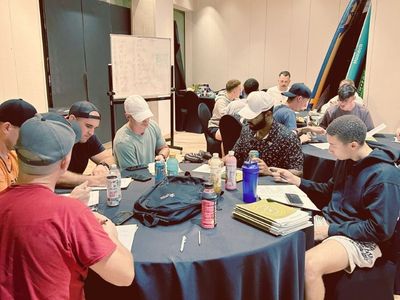
Because many of his students are active duty servicemembers with unpredictable schedules, Sanga meets them wherever learning can happen. That can mean moving between multiple locations on the island, adapting to spaces that don’t resemble traditional classrooms.
“Education isn't about the building; it’s about the readiness to instruct and the hunger to learn,” he said. “The world is our classroom. Teaching adult learners in an accelerated seven-week format requires two things: flexibility and focus.”
Sanga sees math not as an isolated subject but as a collaborative endeavor. The wide age range among UMGC students makes that approach especially powerful.
“There are younger airmen and older airmen, and they were raised using different methods of learning mathematics,” he said “They both got the right answer, but they took different routes to get there. They learn from their peers how to use those different routes. With that, their reasoning becomes sharper.”
Alvin Sanga, EdD UMGC Math Professor, Guam
Practical math for real missions
Examples from daily military life—fueling aircraft, reading maps, or even comparing gas prices on and off base—quickly become teachable moments.
“Doesn’t that take math? Isn’t fueling a plane a problem of volume? Isn’t it an algebra concept?” he asks his students. Once they see the connections, he adds, word problems start to feel less abstract and more like tools they already use.
“All of those are practical questions, and it made sense to them when they are turned into word problems,” he said. “It gives them a tactile feel to what the math is actually doing.”
For deployed students who may not have access to laptops, Sanga adjusts his teaching again. He sends assignments through instant messaging applications and administers quizzes using digital forms. These small adaptations help ensure that learning can continue anywhere in the world.
And while access matters, so does depth. Even with digital tools and the rise of AI, Sanga still encourages students to work problems out by hand whenever possible.
Working it out on paper “still makes a world of difference,” he said. “It makes using your brain a little bit quicker.”